Why Your CNC Schedule Fails Every Single Day.
Daily production plans break not because of poor scheduling, but because of unstable inputs and hidden workflow distortions.
Based on observed patterns across mid-sized CNC job shops.
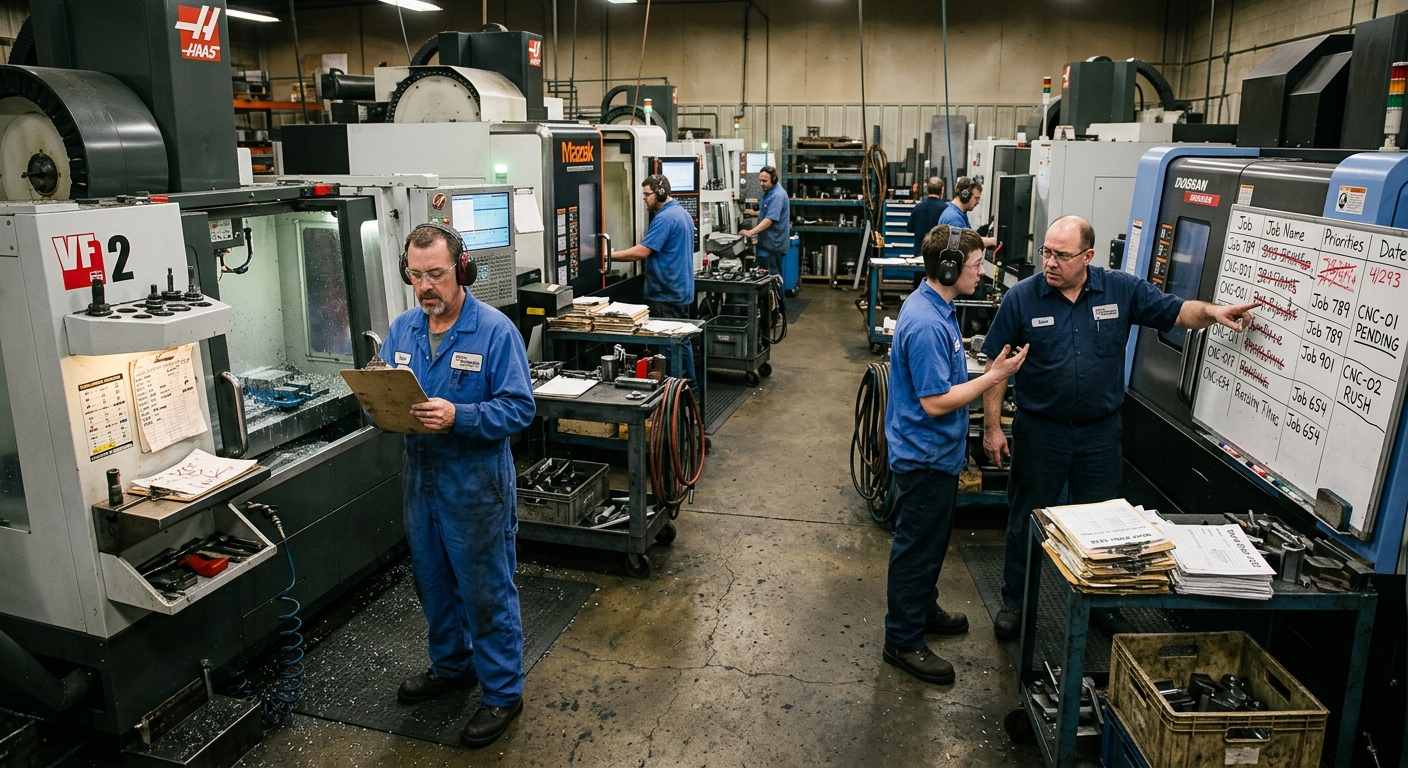
Daily production plans break not because of poor scheduling, but because of unstable inputs and hidden workflow distortions.
Based on observed patterns across mid-sized CNC job shops.
1. The Problem (Pain Trigger)
Every morning begins with a new plan.
By afternoon, the initial plan has already been broken.
• The machine sits idle, waiting for the next job.
• Operators are asking, "What's next?"
• Urgent jobs suddenly appear in the queue.
• Setup time exceeds the planned one.
• The plan finalized in the morning becomes irrelevant by afternoon, and by the end of the day, no one knows:
• What was actually completed
• What is delayed
• Or what caused the plan to fail?
So the next day, you repeat the same process again—with a "revised" schedule.
And it breaks again.
2. What Most People Think (Common Belief)
Most shops believe:
• Our scheduling isn't strong enough.
• We need better planning.
• Maybe we need software or ERP for optimization.
• The planner needs to be more strict.
So they respond by:
• Frequently updating schedules.
• Adding buffers.
• Pushing operators to follow the plan.
• Trying new scheduling tools.
But nothing really stabilizes.
3. Why That's Wrong
Because scheduling isn't where the problem starts.
A schedule doesn't fail at the workshop.
It fails before it's even created.
What you're calling a "schedule problem" is actually:
• A distorted input problem
• A visibility problem
• A structural workflow problem
You're trying to control the output without controlling what feeds into it.
So, no matter how "good" your schedule looks on paper, it's built on unstable ground.
4. What's Actually Happening Operationally
Let's walk through a typical real-world scenario.
A Job enters production.
On paper:
• Estimated cycle time: 12 minutes
• Setup time: 25 minutes
• Machine allocated: VMC-2
But the reality is:
• The drawing had an ambiguity → operator spends extra 15 minutes to figuring it out
• Tool is not available → 20 minutes lost arranging it
• Previous job overran → machine is not free when expected
• Operator assigned is less experienced → cycle time become 16 minutes
Now multiple this across 20-50 jobs running in parallel.
What happens?
• Your "planning capacity" is completely off
• Your machine loading is distorted
• Your sequence collapses
• Small deviations compound into full-day disruptions
And then:
One urgent order arrives.
Since the system is already unstable:
• It gets pushed in manually.
• Everything else shifts
• No one recalculates the impact properly
Now your schedule isn't just broken. it's irrelevant.
5. What it Leads To (Real Impact)
This isn't just an operational inconvenience.
It directly impacts your business:
📉 Delivery Reliability Drops
You stop trusting your commitments.
Customers start following up more.
📉 Machine utilization Looks High - but isn't.
Machines are "busy" but not productive.
You're absorbing inefficiency, not creating throughput.
📉 WIP Starts Increasing
Jobs pile up between stages.
Your have more work in the system, but slower output.
📉 Firefighting Becomes Normal
Your team spends more time reacting than executing.
📉 Margin Erosion
Extra setups, delays, rework, idle time - they don't show clearly, but they eat away at your margin daily.
6. What needs to be changed (Direction, Not Solution)
You can't fix this by improving your schedule.
To fix this you have to stabilize what feeds scheduling.
That means:
• Structuring how jobs enter production
• Validating inputs before they reach the shop floor
• Creating visibility into real machine capacity (not assumed capacity)
• Controlling how and when priorities change
• Reducing variability before it compounds
In simple teams:
👉 Stop treating scheduling as a control tool.
👉 Start treating it as an output of stable system
Until your inputs are reliable, your schedule will always fail - no matter who creates it.
7. Operational Review
If your schedule is broken every day, it is not a planning issue - it is a system issue.
In an Operational Workflow Review, we break this down with you:
• Where your scheduling is getting distorted
• What's creating instability in your production flow
• Which inputs are silently breaking your plan
This is not a generic consultation.
It's a structured look at how your shop actually runs.
If you're serious about fixing the problem - not just managing it - request an operational review.